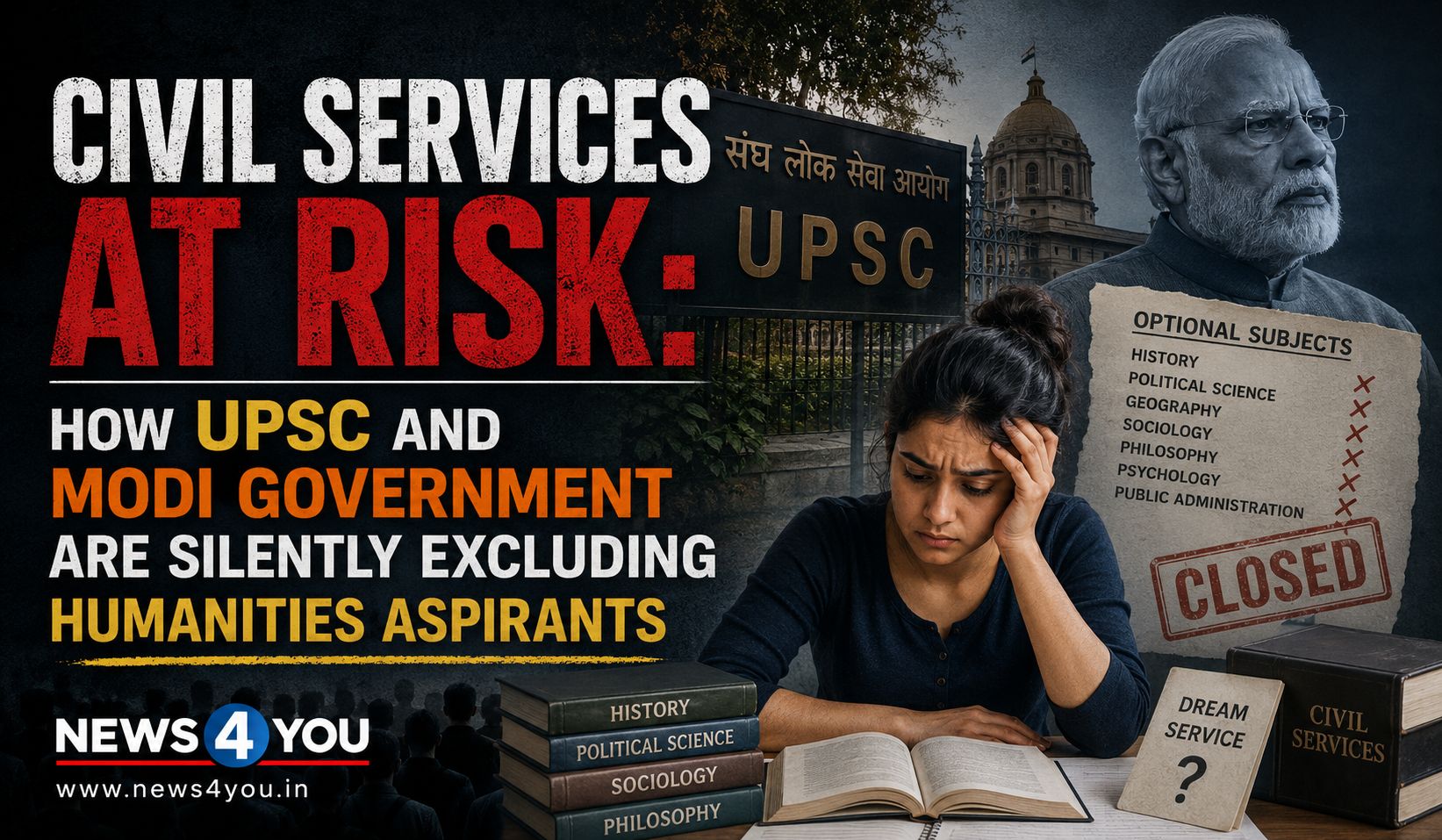
A Quiet Shift in India’s Steel Frame
The Civil Services Examination (CSE) has long been celebrated as the gateway to India’s most prestigious administrative positions. It was meant to draw talent from every discipline — humanities, commerce, science, and engineering — ensuring governance reflected the country’s diversity. Yet, in recent years, an undeclared but unmistakable shift has taken place. The Modi government, working in tandem with the Union Public Service Commission (UPSC), appears to have tilted the playing field decisively in favor of candidates from science and engineering backgrounds, while systematically marginalizing aspirants from humanities and commerce.
The CSAT Bias
The Civil Services Aptitude Test (CSAT), once intended as a qualifying paper, has been reframed to disproportionately favor those trained in mathematics, logical reasoning, and technical problem‑solving — areas where engineers naturally excel. Similarly, the General Studies papers increasingly emphasize data interpretation and quantitative analysis, leaving humanities students struggling despite their strengths in critical thinking, social analysis, and administrative insight. This is not a neutral evolution; it is a deliberate narrowing of the examination’s scope.
Erosion of Diversity and Democratic Ethos
The consequences of this bias are profound. Where once the corridors of power were enriched by historians, sociologists, economists, and political scientists, today they are increasingly populated by engineers and technocrats. This narrowing of intellectual backgrounds undermines the very purpose of the civil services: to provide balanced, empathetic, and socially attuned governance. India’s governance challenges are not merely technical; they are deeply social and political. From agrarian distress to communal tensions, from gender inequality to environmental justice, solutions require nuanced understanding of history, culture, and society. By privileging engineers over historians, technocrats over sociologists, the UPSC is hollowing out the intellectual foundation of the civil services.
The Technocratic Trap
Administration is not about solving equations or designing machines. It is about managing people, resolving conflicts, and crafting policies that resonate with the lived realities of citizens. These are precisely the skills nurtured in the humanities and commerce disciplines — skills now being sidelined. Many of the new entrants into the civil services, while technically proficient, lack the administrative acumen and socio‑political sensitivity required for effective governance. Their training has not prepared them to grapple with issues of poverty, inequality, caste dynamics, or grassroots development. Instead, they approach administration as a technical problem to be solved, often ignoring the human dimensions that make governance complex. This technocratic approach risks turning civil servants into bureaucratic automatons — “certified corruption specialists,” shielded by the government but disconnected from the people they are meant to serve.
A Silent Policy, A Loud Consequence
The Modi government’s silence on this issue is telling. By refusing to acknowledge the bias, it allows the UPSC to continue reshaping the examination in ways that suit its vision of governance — one dominated by technocrats loyal to the system rather than independent thinkers capable of challenging it. This undermines the very spirit of the civil services, which were meant to act as a check on political excesses and ensure continuity of governance beyond partisan agendas.
The Way Forward
If this trend continues, the civil services risk becoming a parody of themselves. Instead of being the steel frame of India, they will become a brittle shell, staffed by individuals ill‑equipped to handle the complexities of administration. Governance will be reduced to technical compliance, while corruption and inefficiency thrive under the veneer of technocratic competence. The erosion of humanities representation is not just an academic issue; it is a threat to the quality of governance and the health of Indian democracy.
The UPSC must reaffirm its commitment to diversity by designing papers that test not just technical skills but also social awareness, ethical reasoning, and administrative judgment. The Modi government, if serious about good governance, must ensure that the civil services remain open to all disciplines, not just engineering and science. India’s challenges are too complex to be solved by technocrats alone; they require the wisdom of historians, the insight of sociologists, the pragmatism of economists, and the empathy of philosophers.
Conclusion
The civil services were envisioned as a melting pot of talent, drawing from every corner of India’s intellectual landscape. To close the door on humanities aspirants is to betray that vision. It is time to call out this undeclared policy for what it is: a corrosive attempt to reshape governance in the image of technocracy, at the expense of democracy. Unless corrected, the civil services will cease to be the steel frame of India and instead become a hollow edifice — a big joke played on the nation by those entrusted to protect it.
Read Also: