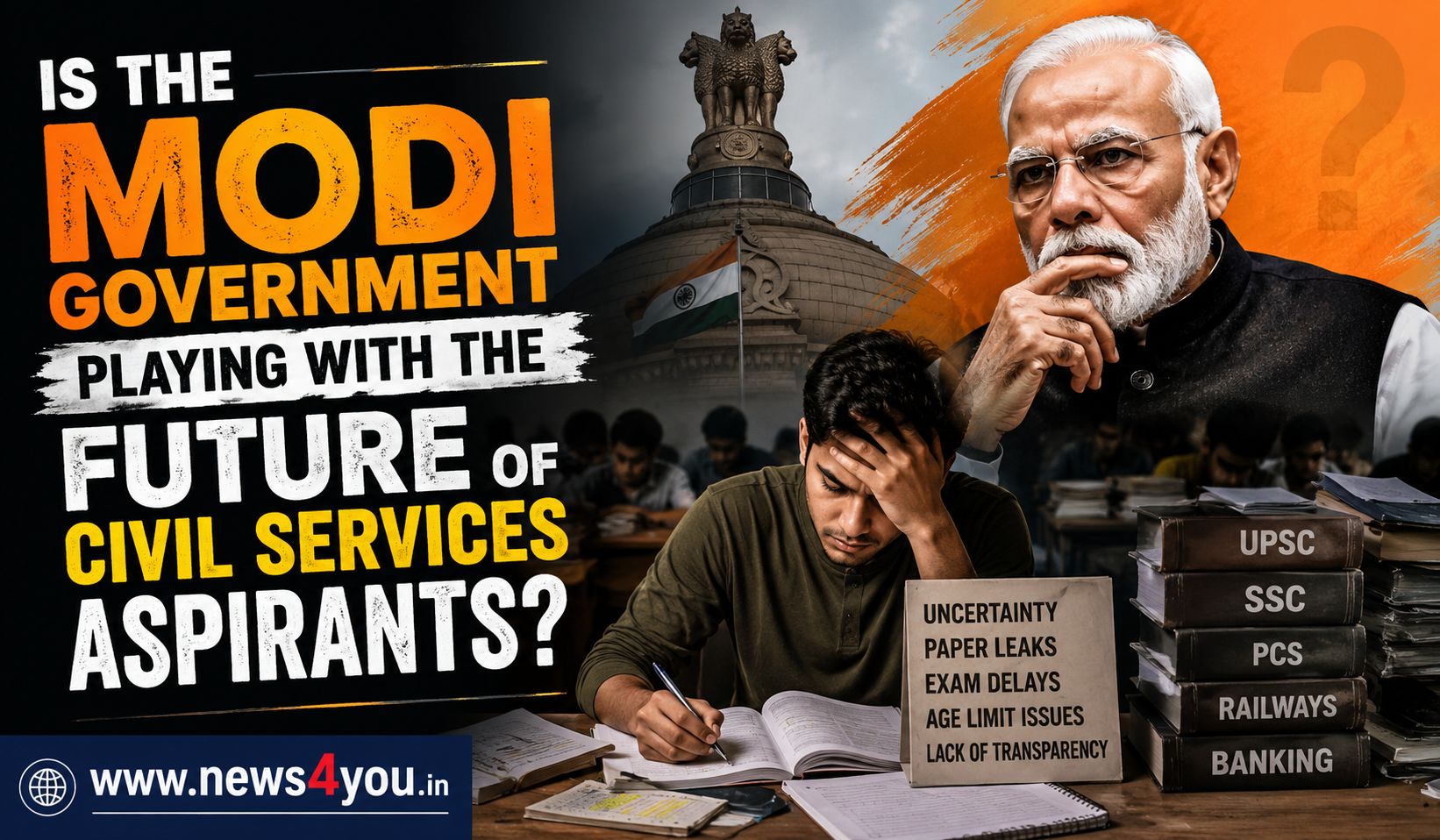
The Civil Services Examination conducted by the Union Public Service Commission has long been regarded as one of the most prestigious and competitive examinations in India. Every year, several lakhs of young aspirants dedicate their prime years to preparing for this examination with the dream of serving the nation through the Indian Administrative Service, Indian Police Service, Indian Foreign Service and other elite services. However, after the recently conducted Civil Services Preliminary Examination 2026, a serious debate has once again emerged across the country: Is the system becoming unfair, unstructured and disconnected from its own declared syllabus?
A large section of aspirants and coaching experts believe that the UPSC Preliminary Examination 2026 was excessively unpredictable and poorly aligned with the officially declared syllabus. Instead of focusing on subjects such as polity, history, geography, economy, governance, international relations and social issues, many questions appeared to test obscure analytical and technical abilities that had little connection with the traditional expectations of a future civil servant.
The biggest criticism is that the examination pattern over the last several years has increasingly favoured candidates from technical and engineering backgrounds. Aspirants from humanities, commerce and other academic streams often complain that the nature of questions now demands a style of problem-solving and elimination that engineering students are naturally more familiar with due to their academic training. While diversity in educational backgrounds should ideally strengthen the civil services, many aspirants now feel that the present pattern indirectly sidelines non-technical candidates.
This perception has created enormous frustration among students who spend years studying the officially prescribed syllabus, only to encounter questions that appear disconnected from it. The result is growing uncertainty and psychological pressure. Aspirants no longer know what to study, how to prepare or what the examination actually intends to evaluate. When an examination becomes excessively unpredictable, merit itself becomes questionable.
The civil services are not merely technical jobs. Administrators are expected to understand society, public welfare, governance, constitutional values, rural realities and human behaviour. A good civil servant requires empathy, communication skills, balanced judgment and administrative understanding. Critics argue that an examination dominated by abstract analytical puzzles and unconventional questions may fail to identify these qualities.
Many aspirants also fear that the current trend discourages talented candidates from humanities and social science backgrounds who traditionally brought strong understanding of governance, sociology, history and public administration into the bureaucracy. India’s administrative structure historically benefited from officers with diverse educational experiences. If the system gradually begins favouring one academic stream over others, it may reduce intellectual diversity within the bureaucracy itself.
Another major concern is the lack of transparency regarding the changing pattern. UPSC officially releases a syllabus every year, and candidates prepare according to it. However, if the actual paper repeatedly deviates from the expected areas, aspirants naturally question the credibility of the examination process. Students invest enormous amounts of time, money and emotional energy in preparation. Many move away from their families, spend years in coaching hubs like Delhi’s Mukherjee Nagar and Old Rajinder Nagar, and sacrifice employment opportunities in the hope of success. When the examination appears disconnected from its own framework, disappointment turns into anger.
There is also growing criticism regarding the overemphasis on elimination tricks and guesswork. Several candidates after the 2026 examination stated that even highly prepared students struggled to identify correct answers confidently because many questions were framed in an ambiguous and highly twisted manner. Such an approach may reward risk-taking strategies more than actual knowledge.
The government and UPSC must understand that the credibility of the civil services examination rests on public trust. If lakhs of aspirants begin believing that the examination is becoming highly manipulated, arbitrary and detached from its declared objectives, the institution itself risks losing its moral authority. A national-level examination of such importance cannot operate in a manner where students feel they are preparing blindly.
Meaningful reforms are urgently required. UPSC should clearly define the scope of questions, maintain consistency with the declared syllabus and ensure balanced representation of subjects relevant to governance and administration. The examination should test awareness, judgment, ethical reasoning and understanding of society rather than excessively obscure or technical questioning.
India deserves a bureaucracy that represents the diversity of its people and educational backgrounds. The civil services should remain open to talented individuals from humanities, commerce, science, law, medicine, engineering and every other stream. An examination system perceived as biased or excessively unpredictable ultimately harms not only aspirants but also the quality of governance itself.
The anger visible after the Civil Services Preliminary Examination 2026 is therefore not merely about one difficult paper. It reflects a deeper fear among aspirants that the system is slowly drifting away from fairness, transparency and equal opportunity. Whether the government and UPSC choose to address these concerns seriously will determine the future credibility of one of India’s most important institutions.
**********
Read Also: