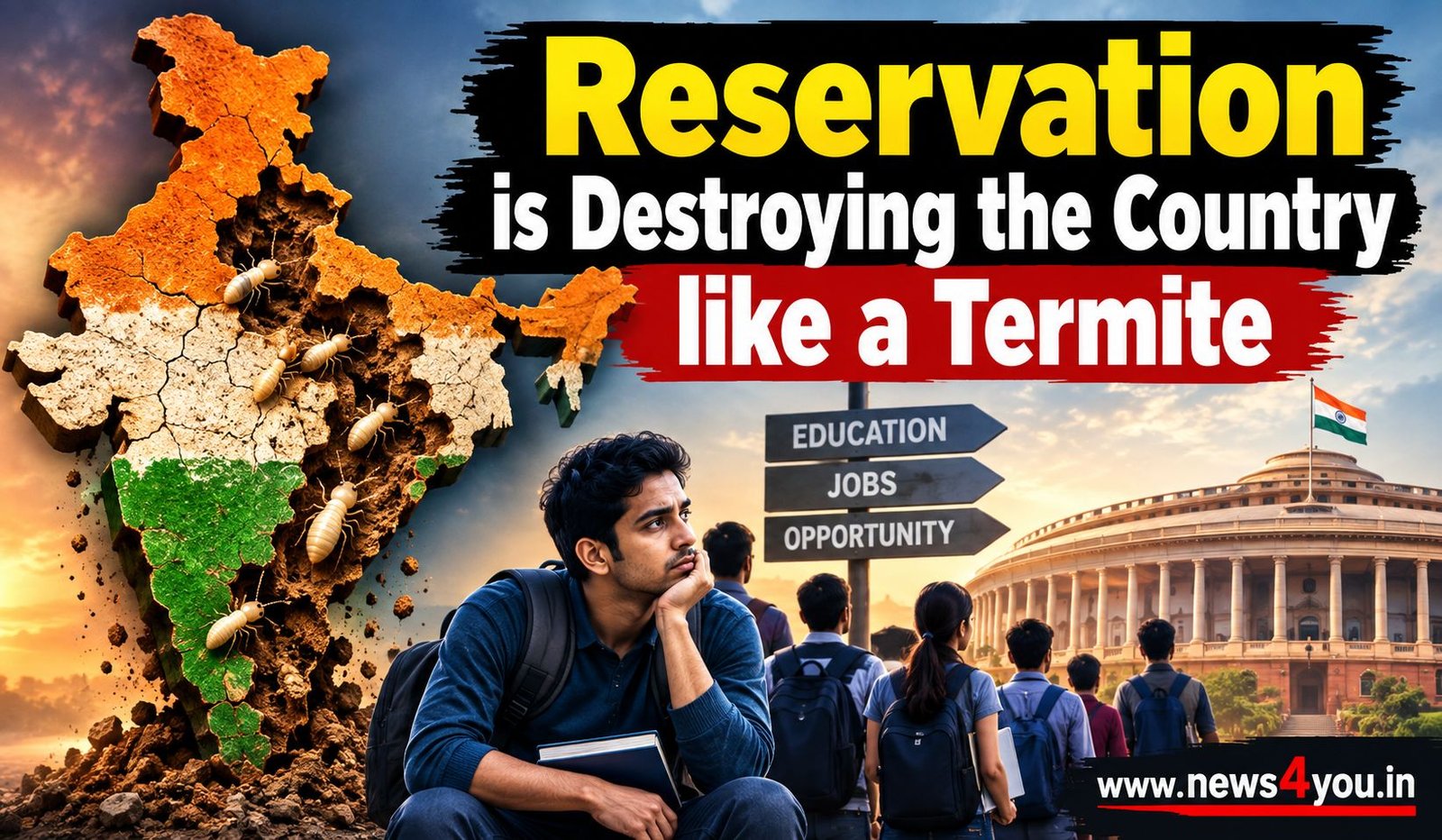
For seventy-five years after independence, India has been carrying a system that was introduced as a temporary crutch but has now become a permanent cancer. That system is caste-based reservation. Like a termite colony, it works silently, invisibly, hollowing out the foundations of merit, efficiency, and national unity from within. From the outside, the building looks intact, but inside, the pillars that hold a modern nation together have been eaten away.
The original argument for reservation was social justice. Dr. B.R. Ambedkar himself, the chief architect of the Constitution, envisaged reservation for only ten years. It was meant to be a short-term measure to uplift the historically backward sections and bring them into the mainstream. What was supposed to be an exception has become the rule. What was supposed to be ten years has become an indefinite entitlement that no political party dares to touch. From 22.5% in the beginning, reservation today has crossed 60-65% in many states, with demands for 80-90% emerging every election season.
1. Murder of Merit
The most direct and devastating impact of reservation is the systematic murder of merit.
In every medical college, engineering college, civil service, and public sector job, we are telling a brilliant student who scored 95% that he is worthless, and telling a mediocre student who scored 45% that he is entitled to the seat because of his birth. What kind of doctors will such a system produce? What kind of engineers will build our bridges? What kind of bureaucrats will run our administration?
When a deserving general category student is denied admission despite years of hard work, while a reserved category student with half his marks takes his place, we are not doing social justice. We are punishing excellence and rewarding mediocrity. A nation that punishes its best and brightest cannot compete with the world. China, USA, Israel, Japan – none of them have a system where 70% of seats are given on the basis of birth. They select the best. We select on the basis of caste certificate.
The result is a massive brain drain. The most talented youth of this country, who find themselves discriminated against in their own motherland, are leaving for America, Canada, and Europe. Reservation has become the biggest export promotion scheme for foreign countries – we are exporting our merit, and importing mediocrity.
2. Casteism Has Not Ended, It Has Become Stronger
Proponents of reservation argue that it will end casteism. The reality is exactly the opposite. Reservation has made caste immortal.
Before 1990, urban India was slowly moving away from caste identity. Inter-caste marriages were increasing, surnames were becoming less important. Then came the Mandal Commission implementation and we officially divided the country into General, OBC, SC, ST. Today, a child who is born in India does not learn his nationality first, he learns his category. Every form, from school admission to a job to even a death certificate, asks for his caste.
We have created a system where it is profitable to be backward. No community wants to be called forward. Everyone wants to be declared backward to get the benefits of reservation. The Jats, the Marathas, the Patels, the Gujjars – all powerful, politically dominant communities are agitating on the streets demanding to be called backward. This is not the eradication of caste. This is the glorification of caste for political gain.
Reservation has created a vested interest in remaining divided. Why would any leader want caste to end when his entire vote bank depends on it?
3. The Creamy Layer and the Betrayal of the Truly Needy
The most cruel joke of reservation is that it does not even help those it was meant to help.
After 75 years, the benefits of reservation are being cornered by the creamy layer – the sons and daughters of IAS officers, MPs, MLAs, and wealthy families belonging to reserved categories. A child of an SC officer living in Lutyens’ Delhi, studying in a top private school, gets reservation, while a poor Brahmin or Rajput or Baniya child living in a village in Uttar Pradesh, whose father is a marginal farmer, gets nothing because he is from the “forward” caste.
Is this social justice? Has poverty become caste-specific? The Constitution says the State shall not discriminate on grounds of caste, but reservation does exactly that. It says poverty, backwardness, and need exist only in certain castes. The poor among the upper castes are invisible to this system. They are punished twice – once by poverty, and second by the system which denies them any support because of their surname.
The truly poor SC/ST person living in a remote village still remains where he was. He does not get the benefit. The benefit is taken away by the elite within his own community. Reservation has thus created two Indias within the reserved categories themselves – one super-rich creamy layer that perpetuates reservation for its own children, and one extremely poor class that remains a mere statistic.
4. Against the Basic Structure of the Constitution
Ultimately, the caste-based reservation system is against the very soul of the Constitution of India.
The Preamble of our Constitution promises EQUALITY of status and of opportunity to all citizens. Article 14 promises equality before the law. Article 15(1) explicitly says – The State shall not discriminate against any citizen on grounds only of religion, race, caste, sex, place of birth. Article 16(1) promises equality of opportunity in matters of public employment.
Reservation based purely on caste is a direct violation of all these articles. It is discrimination on the basis of birth, which is exactly what our Constitution makers wanted to end.
The Supreme Court, in its attempt to balance, created the fiction of “reasonable classification” and put a 50% cap in the Indra Sawhney judgment. That cap has now been thrown into the dustbin by politicians. We have EWS, then state-wise extra quotas, taking the total to 70-80%. The basic principle of equality has been reduced to a joke.
How can a system that divides citizens into different classes at birth, gives different rights based on caste certificates, and denies merit any value, be called constitutional? It is against Article 14, against Article 15, against Article 16, and against the basic structure of equality and secularism. A Constitution that was meant to make us casteless has been used to make us permanently casteist.
The judiciary has itself become a party to this unconstitutional expansion by failing to strike it down definitively.
Conclusion: Time to End This Termite System
A termite does not destroy a house in one day. It eats it slowly, day after day, until one day the house collapses on its own.
Reservation is that termite. It is destroying efficiency, destroying unity, destroying the faith of the youth in hard work, and destroying the constitutional promise of equality.
Social justice does not mean permanent caste quotas. If the aim is to help the poor and backward, the only constitutional and moral criteria can be economic backwardness, not caste. Give free education, give scholarships, give financial help, give coaching to anyone who is poor, irrespective of his caste. But once they enter the classroom or the examination hall, let everyone be judged equally.
The day is not far when the country will have to choose between two paths – either continue with this ever-increasing caste reservation and become a mediocre, divided, backward nation, or abolish caste-based reservation and become a merit-based superpower.
India cannot have both merit and caste reservation. One has to die for the other to live. If we want to save the country, we will have to end this unconstitutional system that is eating it like a termite from within.
*****************
Read also :
For Stock Market related News and Updates, please visit our Group website regularly: