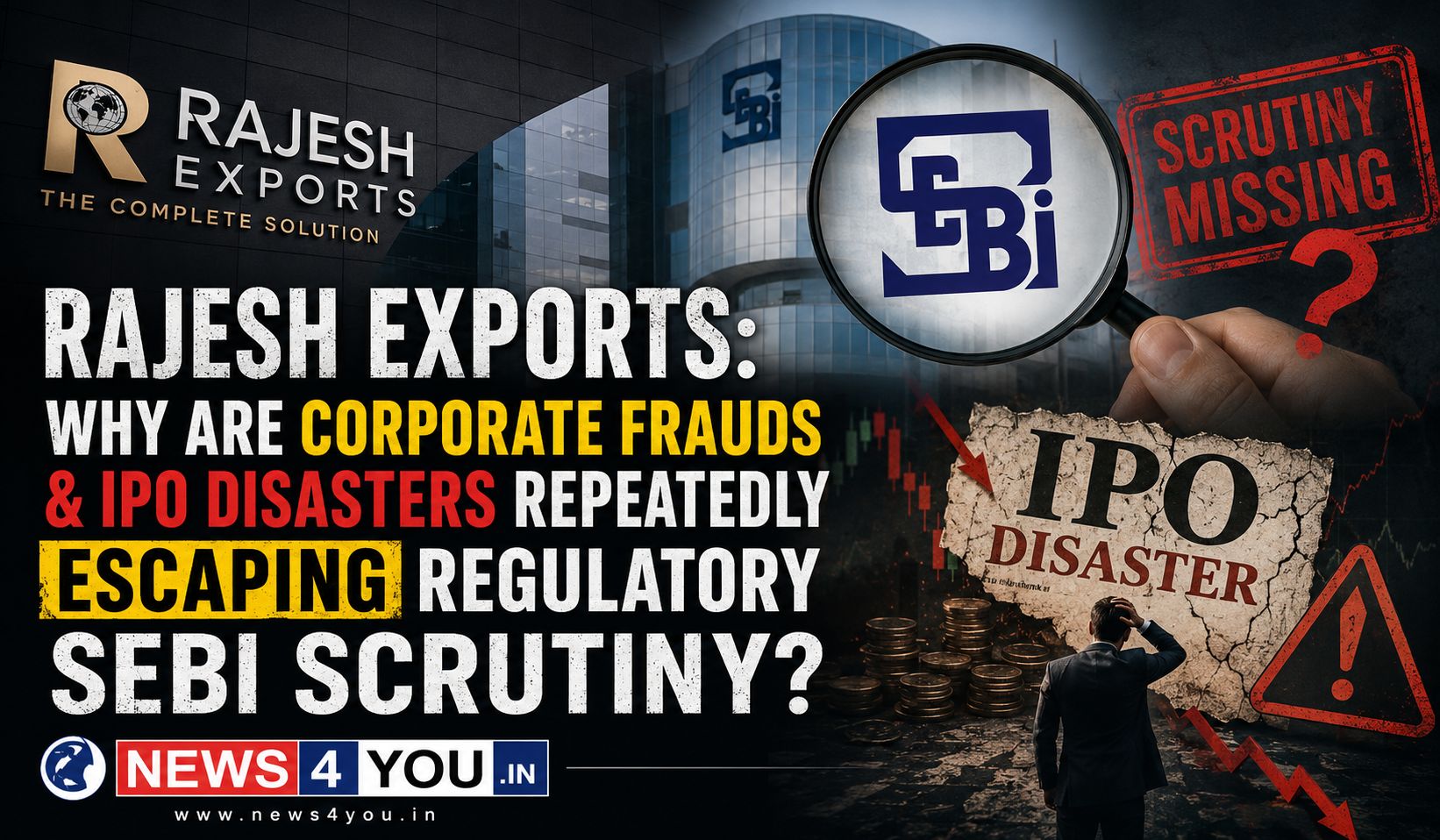
The recent regulatory action and scrutiny surrounding Rajesh Exports Ltd. have once again raised uncomfortable questions about the effectiveness of India’s market watchdog, the Securities and Exchange Board of India (SEBI). While regulators often spring into action after problems become visible, investors are increasingly asking a simple question: Where was SEBI when the alleged irregularities were taking place?
The Rajesh Exports episode is not merely about one company. It has become a symbol of a much larger concern that has been troubling India’s capital markets for years. Time and again, investors have witnessed companies reporting impressive financial numbers, attracting institutional and retail investors, and even securing lofty valuations in the stock market. Yet, after a few years, many of these companies find themselves facing allegations related to governance failures, accounting irregularities, misleading disclosures, or questionable business practices.
SEBI’s primary mandate is to protect investor interests, regulate the securities market, and promote fair and transparent market practices. To achieve these objectives, the regulator has put in place a comprehensive framework that includes periodic disclosures, corporate governance requirements, auditor certifications, stock exchange monitoring, insider trading regulations, and surveillance systems.
On paper, the mechanism appears robust. Listed companies are required to submit quarterly financial statements, disclose material developments, comply with governance norms, and undergo statutory audits. Stock exchanges conduct surveillance, while SEBI possesses extensive investigative and enforcement powers.
Yet repeated corporate scandals raise concerns about whether the system is functioning effectively.
One of the biggest criticisms of the current regulatory framework is that enforcement often appears reactive rather than preventive. By the time investigations begin, share prices may have already collapsed, promoters may have exited, and retail investors may have suffered significant losses. Regulatory orders frequently arrive years after the alleged violations occurred, offering little consolation to investors whose wealth has already been destroyed.
The IPO market presents an even more troubling picture. Over the past few years, India has witnessed a boom in public offerings. Many companies have come to the market with aggressive valuations, commanding prices that appeared disconnected from their financial performance or long-term profitability. Despite extensive disclosures in offer documents, several IPOs have witnessed dramatic price declines after listing.
In numerous cases, stocks that debuted with great fanfare have eventually traded 50%, 70%, or even 80% below their issue prices. Retail investors, lured by marketing campaigns, analyst recommendations, and the fear of missing out, often bear the brunt of these losses.
Critics argue that SEBI’s approval of an IPO is frequently interpreted by ordinary investors as a seal of quality, even though the regulator repeatedly clarifies that it does not certify the commercial merits of an issue. The distinction may be legally correct, but in practice, many retail investors assume that a company receiving regulatory clearance has passed a rigorous quality assessment.
This perception gap has serious consequences.
Market experts point out that SEBI’s review process largely focuses on disclosure compliance rather than valuation justification. As long as risks are disclosed and procedural requirements are met, companies can seek public money at valuations that some analysts consider excessive. The market is then expected to determine the appropriate price.
However, when information asymmetry exists between promoters and retail investors, this market-based approach may not always deliver fair outcomes.
The larger concern is whether India possesses adequate real-time forensic surveillance mechanisms to identify red flags before they become full-blown crises. Sudden spikes in receivables, unusual related-party transactions, rapid revenue growth without corresponding cash flows, repeated auditor resignations, and complex subsidiary structures often emerge as warning signals in troubled companies. Investors question whether such indicators are receiving sufficient regulatory attention at an early stage.
Defenders of SEBI argue that no regulator in the world can prevent every fraud. Even advanced markets such as the United States have witnessed major corporate collapses despite the presence of powerful regulators. They also note that SEBI has significantly strengthened disclosure norms, enhanced surveillance technology, imposed substantial penalties, and increased enforcement actions over the years.
Nevertheless, public confidence depends not merely on enforcement but on timely enforcement.
The Rajesh Exports controversy has reignited a debate that extends far beyond a single company. Investors want assurance that regulatory systems can detect problems before wealth is destroyed rather than after the damage is done. They want greater accountability from auditors, merchant bankers, independent directors,credit rating agencies, and regulators alike.
India’s capital markets have matured rapidly and attracted millions of first-time investors. For this trust to endure, regulatory oversight must evolve at the same pace. Otherwise, every new corporate scandal will continue to raise the same troubling question: Is the watchdog protecting investors, or merely documenting the damage after it has already occurred?
Read Also:
Also Read :
How to make money from share market? (indiatimes.com)
Visit our another Group Website regularly for more such Educational Research Articles:
MoneyInsight – We Provide Insight to Your Money
Visit & Subscribe our Devotional Music Channel on YouTube:
Indian Devotional Music – YouTube
Visit our Website regularly for more such Educational Research Articles:
News4You – News & Views On Personal Finance & Share Market