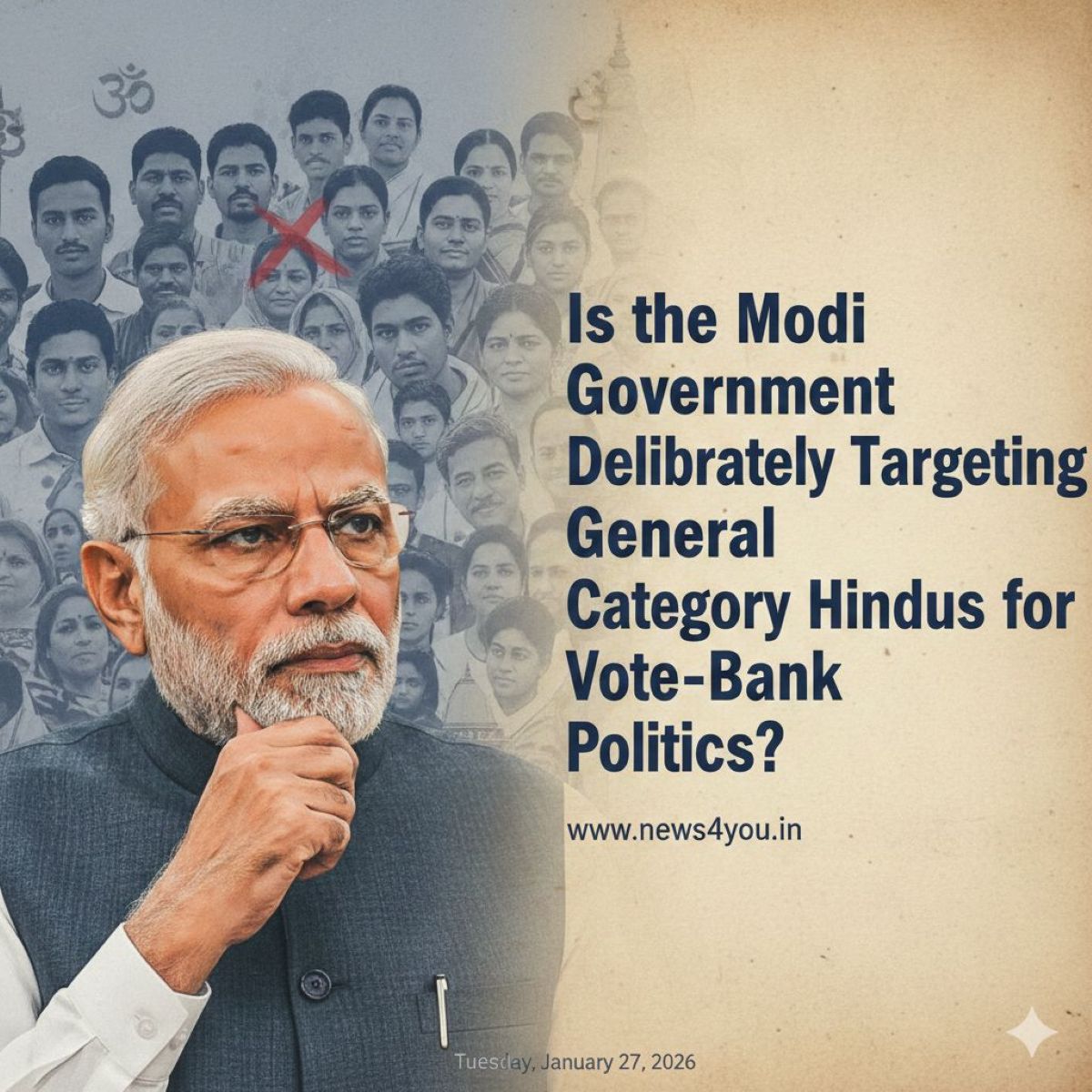
UGC Regulations Controversy: A disturbing question is increasingly being asked in educated and middle-class Hindu households across India: has the Modi government consciously chosen to sacrifice General Category Hindus at the altar of vote-bank politics? What was once projected as “social justice” now appears, to many, as a calculated political strategy to consolidate caste and minority votes by systematically weakening the rights, opportunities, and dignity of upper-caste Hindus.
The government’s approach to reservations is the first glaring example. Reservations were never meant to be permanent. The Constitution envisaged them as a temporary corrective tool, not an eternal political instrument. Yet instead of reviewing or gradually rationalising the system, the Modi government has preserved and expanded it, ensuring that nearly every election is fought by promising more quotas to more groups. In this race to appease, merit and fairness have become casualties. General Category students compete in brutally unequal conditions, while political parties convert caste arithmetic into electoral currency.
Even more alarming is the government’s handling of the SC/ST (Prevention of Atrocities) Act. No sensible citizen disputes the need to protect vulnerable communities from genuine oppression. But when the Supreme Court attempted to introduce basic safeguards against misuse, the Modi government rushed to nullify them through legislation. The message was loud and clear: appeasement matters more than justice. By refusing to build in penalties for false cases and by restoring automatic arrests, the government knowingly created a law that can be misused as a weapon of intimidation. Professionals, teachers, entrepreneurs, and students now live under the constant fear that a single accusation—true or false—can destroy careers and families overnight. If this is not deliberate political signalling to a vote bank, what is?
UGC Regulations Controversy: The new UGC regulations and grievance mechanisms in educational institutions further expose this mindset. Instead of strengthening neutral and fair disciplinary systems, the government has institutionalised identity-based Grievance Redressal System, where accusations linked to caste carry extraordinary power. Universities are turning into spaces of suspicion rather than scholarship. The chilling effect on free expression and academic interaction is undeniable—and entirely foreseeable.
Economically, the hypocrisy is even starker. General Category Hindus, largely excluded from reservations, are pushed into the private sector and self-employment, bearing a heavy tax burden. That tax finances welfare schemes, subsidies, and benefits designed primarily for politically mobilised groups. Yet when General Category citizens demand relief, scholarships, or support, the state suddenly remembers “fiscal discipline.” This is not governance; this is selective generosity guided by electoral calculations.
The most painful truth is this: no government in independent India has so systematically ignored the anxieties of upper-caste Hindus while simultaneously projecting itself as a protector of Hindu interests. Cultural symbolism has replaced substantive justice. Temple politics and slogans mask a policy framework that steadily marginalises a large, tax-paying, law-abiding section of society.
Vote-bank politics has always damaged Indian democracy. But when it begins to erode equality before law, criminal justice safeguards, and merit itself, it becomes dangerous. A nation cannot remain stable when one group feels permanently targeted and politically expendable.
If the Modi government truly believes in “Sabka Saath, Sabka Vikas,” it must prove it—not with slogans, but by reforming reservations, restoring legal safeguards, and treating every citizen, irrespective of caste, as equal before the law. Otherwise, history may remember this regime not as a reformer, but as one that institutionalised division for electoral gain.
Read Also:
Also Read :
How to make money from share market? (indiatimes.com)
Visit our another Group Website regularly for more such Educational Research Articles:
MoneyInsight – We Provide Insight to Your Money
Visit & Subscribe our Devotional Music Channel on YouTube:
Indian Devotional Music – YouTube
Visit our Website regularly for more such Educational Research Articles:
News4You – News & Views On Personal Finance & Share Market