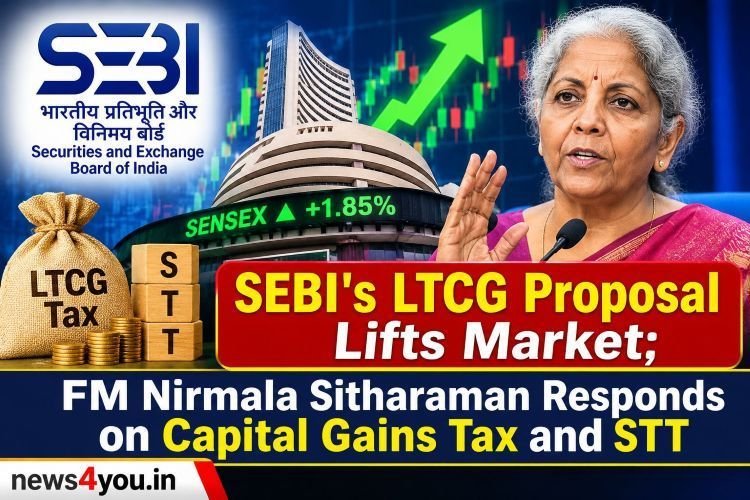
SEBI’s LTCG Proposal Lifts Market; Finance Minister Nirmala Sitharaman Responds on Capital Gains Tax and STT
The taxation of equity investments has once again become a subject of discussion in India’s financial markets following discussions around the Securities and Exchange Board of India’s (SEBI) proposal concerning Long-Term Capital Gains (LTCG) tax. The issue has attracted attention from investors, market participants and financial experts, particularly because changes in capital gains taxation and Securities Transaction Tax (STT) can influence investment decisions, stock market trading volumes and overall market sentiment.
It is important to distinguish between SEBI’s recommendations and the government’s final tax policy. SEBI is the capital market regulator, while decisions concerning income tax rates and amendments to tax laws rest with the Central Government.
SEBI Recommends LTCG Exemption for Foreign Investors
According to a Reuters report dated November 2, 2026, SEBI has recommended that the government abolish LTCG tax on equity investments made by Foreign Portfolio Investors (FPIs). The recommendation comes at a time when overseas investors have been withdrawing substantial amounts from Indian equity markets.
Foreign investors have reportedly sold approximately $31 billion worth of Indian stocks during 2026, putting pressure on the domestic stock market and the rupee. India’s equity market has also underperformed several emerging markets, increasing concerns about its attractiveness to international investors.
Apart from proposing the removal of LTCG tax for foreign investors, SEBI has reportedly suggested providing tax relief to domestic mutual fund investors. Under this proposal, investors switching from one mutual fund scheme to another could be exempted from LTCG tax if their existing investments have been held for more than one year. The objective is to encourage investors to remain invested in mutual funds rather than withdraw their money because of tax liabilities.
However, these recommendations are part of SEBI’s confidential pre-Budget representations and are not binding on the government. Any changes will require approval from the Finance Ministry and the necessary amendments to the tax laws.
What Did Finance Minister Nirmala Sitharaman Say?
Finance Minister Nirmala Sitharaman has acknowledged the growing concerns of domestic and international investors regarding capital gains taxation.
On November 2, 2026, she indicated that the government would consider requests for reviewing LTCG taxation, particularly in relation to foreign investors. She acknowledged that circumstances had changed and that concerns about the existing tax structure had become louder.
She also emphasised that India’s economic growth is important and that equity capital plays a significant role in supporting investment and economic expansion. Her remarks suggest that the government is willing to examine stakeholder feedback, although she has not announced any immediate reduction or abolition of LTCG tax.
Earlier, on October 13, while speaking at the Bloomberg New Economy Forum, the Finance Minister had also indicated that the government was open to hearing suggestions on LTCG, STT and the taxation of different asset classes. She said that investors, both in India and abroad, had raised concerns about these issues. However, she avoided making any specific commitment because preparations for the Union Budget 2027-28 had already begun.
STT Also Under Government’s Consideration
Another important issue raised by investors is Securities Transaction Tax (STT), which is levied on transactions involving securities traded on recognised stock exchanges. Market participants have argued that the combined burden of STT, LTCG and Short-Term Capital Gains (STCG) tax increases the cost of equity investments in India.
Under the existing tax structure, LTCG on listed equity shares and equity-oriented mutual funds held for more than 12 months is taxed at 12.5% on eligible gains exceeding the annual exemption of ₹1.25 lakh for resident investors. STCG on qualifying listed equity investments is taxed at 20%. STT is charged separately on eligible transactions.
Investors have urged the government to examine the overall tax burden and make Indian markets more competitive compared with other emerging economies. The Finance Minister has acknowledged these concerns but has not announced any decision regarding a reduction in STT or capital gains tax.
Will Union Budget 2027-28 Bring Tax Relief for Stock Market Investors?
The upcoming Union Budget 2027-28 could become important for investors looking for changes in equity taxation. SEBI’s recommendations, continuing foreign investment outflows and representations from market participants have brought the LTCG and STT debate into focus.
However, the government will also have to consider tax revenue, the interests of domestic retail investors and the need to maintain a level playing field between domestic and foreign investors.
For the stock market, any reduction in LTCG or STT could improve investor sentiment and potentially make Indian equities more attractive to foreign funds. Nevertheless, taxation is only one factor influencing investment decisions. Corporate earnings, market valuations, currency movements and global economic conditions will continue to play important roles.
Conclusion: SEBI’s proposal to abolish LTCG tax for foreign portfolio investors and provide tax relief on certain mutual fund switches has opened an important debate on India’s equity taxation framework. Finance Minister Nirmala Sitharaman’s willingness to consider investor concerns has raised expectations of possible tax reforms. However, investors should remember that no change in the existing LTCG or STT structure has been officially announced. The final decision will rest with the government and could become clearer in the Union Budget 2027-28.
Disclaimer: Investments in Capital Market/Share Prices are subject to market fluctuations and are dependent on several factors. These predictions are based on the current market conditions and the future market expectations. Investors are advised to take into consideration all these factors before making any investment in Capital Market. This article should not be treated as Investment advisory and is for general Guidance & Educational purpose only. We keep revising our share price targets based on the latest information available with us. Please keep visiting our website regularly to keep yourself updated. News4You does not offer investment advice and does not encourage any action based on its content.
Read Also:
Also Read :
How to make money from share market? (indiatimes.com)
Visit our another Group Website regularly for more such Educational Research Articles:
MoneyInsight – We Provide Insight to Your Money
Visit & Subscribe our Devotional Music Channel on YouTube:
Indian Devotional Music – YouTube
Visit our Website regularly for more such Educational Research Articles:
News4You – News & Views On Personal Finance & Share Market